
昇思25天学习打卡营第14天|CYCLEGAN
【代码】昇思25天学习打卡营第13天|DCGAN。
The cycle GAN means to transit the style with learning how to generate another kind of style.
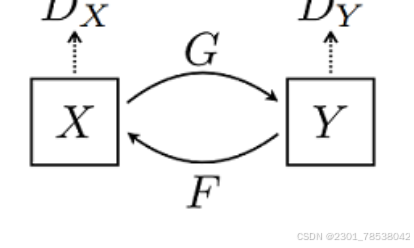
For X we have one style,
For Y we have another,
so for get a picture of Y object with X's style, we just need to learn how to generate the style of X.
The function of loss is period_consistent, you have a X, you use it to generate a X' of Y style, and we then use this X' to generate another X'' of X style. X and X'' are the same style accordingly, and we can compute their cycle_consistency_loss
we show the discriminator here,
class Discriminator(nn.Cell):
    def __init__(self, input_channel = 3, output_channel=64, n_layers= 3, alpha=0.2,norm_mode = 'instance'):
        super(Discriminator, self).__init__()
        kernel_size = 4
        layers = [nn.Conv2d(input_channel, output_channel, kernel_size,2,pad_mode='pad', padding= 1, weight_init = weight_init),nn.LeakyReLU(alpha)]
        nf_mult = output_channel
        for i in range(1, n_layers):
            nf_mult_prev = nf_mult
            nf_mult = min(2**i, 8) * output_channel
            layers.append(ConvNormReLU(nf_mult_prev,nf_mult, kernel_size, 2, alpha, norm_mode, padding = 1))
        nf_mult_prev = nf_mult
        nf_mult = min(2**n_layers, 8) * output_channel
        layers.append(ConvNormReLU(nf_mult_prev, nf_mult, kernel_size, 1, alpha, norm_mode, padding=1))
        layers.append(nn.Conv2d(nf_mult, 1, kernel_size, 1, pad_mode="pad", padding = 1, weight_init=  weight_init))
        self.features = nn.SequentialCell(layers)
    def construct(self,x):
        output = self.features(x)
        return output
net_d_a = Discriminator()
net_d_a.update_parameters_name('net_d_a.')
net_d_b = Discriminator()
net_d_b.update_parameters_name('net_d_b')
to get a better understanding of Generator, we skim the sketch first:
3*256*256 -- CNR(CONV-NORM-RELU) 64, 7*7 -- CNR,upsamp,128,3*3 -- CNR upsamp, 256,3*3 -- ResidualBlock*9 , 256,3*3 -- CTNR(CONV,TRANSPOSE, NORMRELU) 128,3*3 -- CTNR 128, 3*3,--- CONV 3,7*7
class ResNetGenerator(nn.Cell):
    def __init__(self, input_channel=3, output_channel=64, n_layers = 9, alpha =0.2, norm_mode='instance', dropout = False, pad_mode = 'CONSTANT'):
        super(ResNetGenerator, self).__init__()
        self.conv_in = ConvNormReLU(input_channel,output_channel,7,1, alpha, norm_mode, pad_mode = pad_mode)
        self.down_1 = ConvNormReLU(output_channel, output_channel*2, 3, 2, alpha, norm_mode)
        self.down_2  = ConvNormReLU(output_channel*2, output_channel*4,3,2,alpha, norm_mode)
        layers = [ResidualBlock(output_channel *4, norm_mode, dropout=dropout, pad_mode=pad_mode)] * n_layers
        self.residuals = nn.SequentialCell(layers)
        self.up_2 = ConvNormReLU(output_channel * 4, output_channel*2, 3,2,alpha,norm_mode, transpose = True)
        self.up_1 = ConvNormReLU(output_channel*2 ,output_channel, 3,2,alpha,norm_mode, transpose = True)
        if pad_mode =='CONSTANT':
            self.conv_out = nn.Conv2d(output_channel, 3, kernel_size = 7,stride =1, pad_mode = 'pad',padding = 3,weight_init= weight_init)
        else :
            pad = nn.Pad(paddings = ((0,0),(0,0),(3,3),(3,3)),mode=pad_mode)
            conv = nn.Conv2d(output_channel,3,kernel_size=7,stride = 1, pad_mode = 'pad',weight_init = weight_init)
            self.conv_out  = nn.SequentialCell([pad, conv])
    def construct(self, x):
        x = self.conv_in(x)
        x = self.down_1(x)
        x= self.down_2(x)
        x = self.residuals(x)
        x = self.up_2(x)
        x = self.up_1(x)
        output = self.conv_out(x)
        return ops.tanh(output)

net_rg_a = ResNetGenerator()
net_rg_a.update_parameters_name('net_rg_a.')
net_rg_b = ResNetGenerator()
net_rg_b.update_parameters_name('net_rg_b.')
鲲鹏昇腾开发者社区是面向全社会开放的“联接全球计算开发者,聚合华为+生态”的社区,内容涵盖鲲鹏、昇腾资源,帮助开发者快速获取所需的知识、经验、软件、工具、算力,支撑开发者易学、好用、成功,成为核心开发者。
更多推荐

 3
3 0
0- 0


 已为社区贡献23条内容

所有评论(0)